Riders Ready: The Science of BMX
Three sensor-driven STEM interactives that translate real BMX motion like pedaling, building and racing into real-time digital feedback. Designed for Discovery Lab’s children’s museum, built for a multi-year national tour.
Product Design • Interaction Design

Project Overview
Client: Discovery Lab
Team: Trivium Interactive
Timeline: 14 weeks (2024 - 2025)
My Role: Product Designer
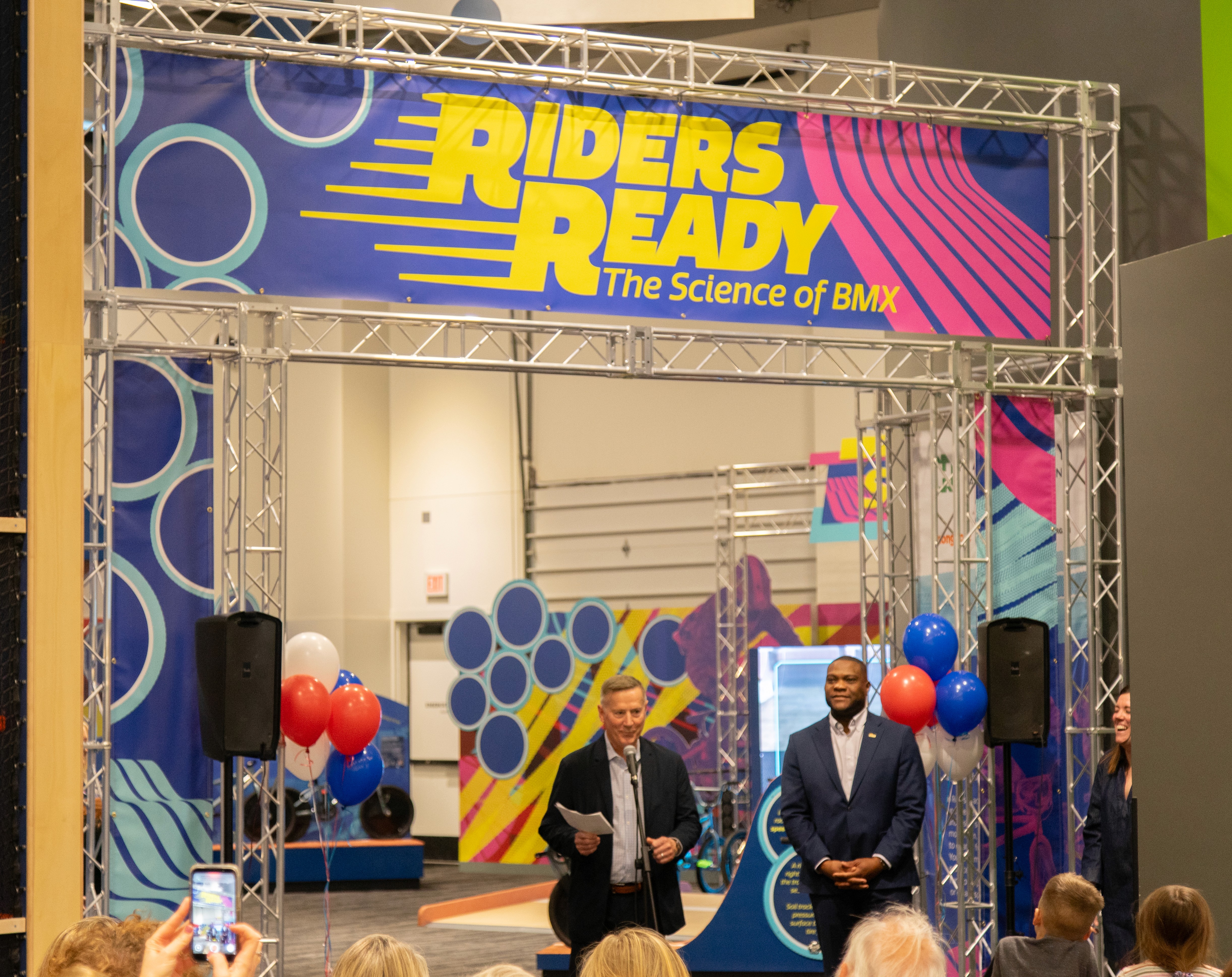
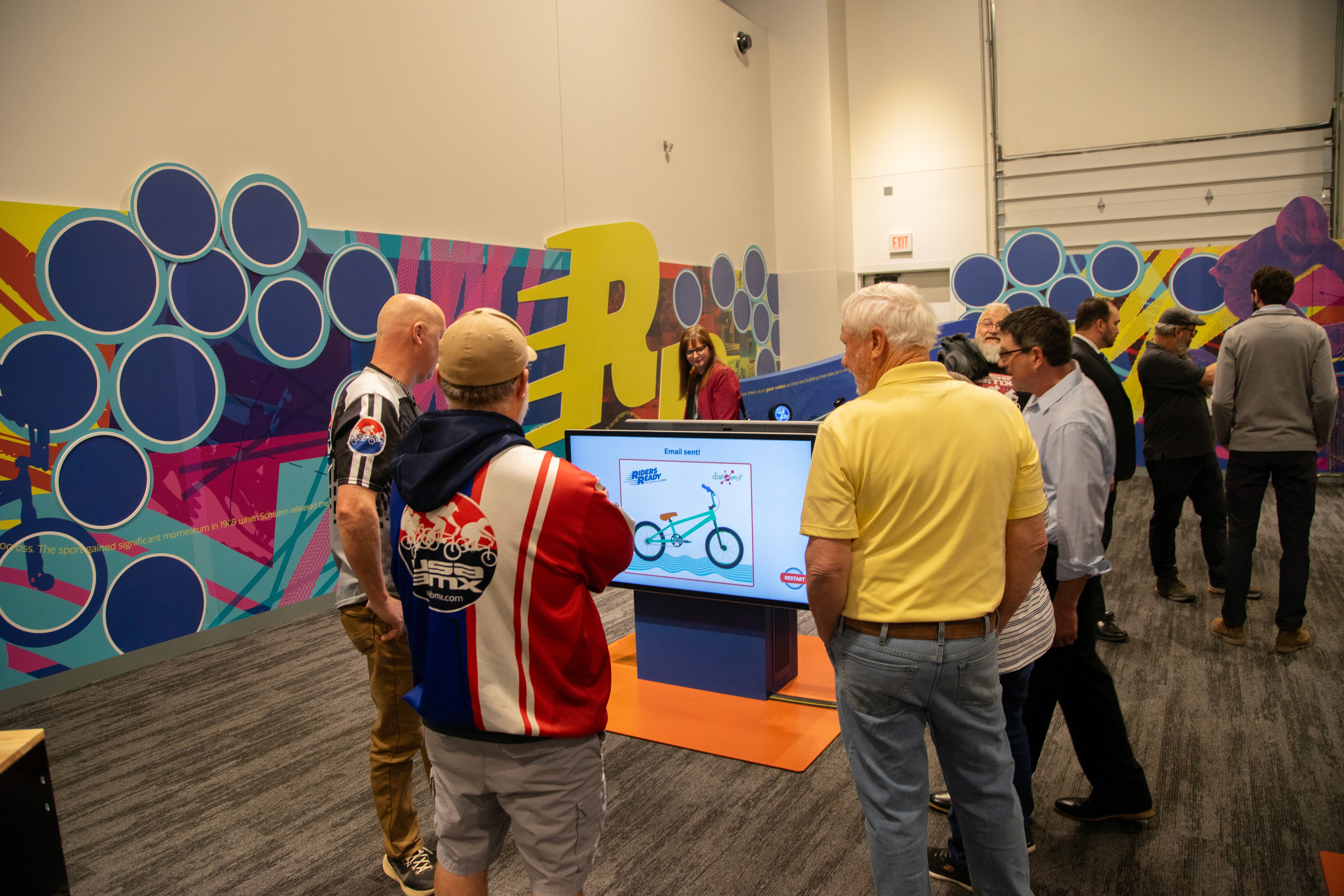
The Science of BMX is a STEM exhibit built for Discovery Lab in Tulsa, OK, with the USA BMX Foundation and the Hardesty Family Foundation. There are three sensor-driven interactives pairing real BMX equipment (a disassembled bike, 3D-printed track pieces, pedal-equipped bike stations) with on-screen feedback that responds to a visitor's physical actions in real time. It opened March 7, 2025, with a ribbon cutting attended by Olympian and BMX pro Cameron Wood, and after 12–18 months at Discovery Lab begins a 7- to 10-year national tour, stopping near the 240+ USA BMX-sanctioned tracks across the country — projected to reach more than 1 million visitors.
My Role
Our team conducted research and held design reviews together, each owning design for our own interactives while giving feedback on the others. I led UX/UI design across all three interactives building modular, CMS-driven UI systems so Discovery Lab staff could update content without engineering support.
I worked with Discovery Lab through review checkpoints to shape the screen flows, designed on-screen feedback for each physical input (touch, pedal sensors, tactile blocks) informed by timing decisions made with engineering and tested screens with visitors, redesigning where they didn't hold up. Collaborated with developers, a 3D artist and Discovery Lab's reviewers. Supported on-site installation and QA through launch.
The Challenge
Each interactive only works if a visitor physically moves when pedaling, placing a block, assembling a part and any noticeable lag between that action and the screen's response breaks the illusion.
Visitors range from kindergarteners to adults, often interacting in groups, with little to no onboarding time.
Three interactives, each on its own hardware, had to ship in about three months (October 17, 2024 kickoff to January 24, 2025 final walkthrough) — with content living in a CMS so Discovery Lab, and future tour venues, could update it without involving Trivium's development team.
Accessibility had to be designed into hardware, not just screens: one of the four Starting Gate bike stations needed to be wheelchair-accessible from day one.
The Solution
Three sensor-driven interactives, each built around a physical action translated into an immediate digital response:
Designed two of the interactives so a physical action gets an instant on-screen response, easing the lag problem.
Built a modular, CMS-driven content system so Discovery Lab could update it without engineering.
Kept instructions minimal so visitors of any age could jump in.
Built each interactive as a game-like experience so STEM concepts were learned through play, not instruction.
Research Process
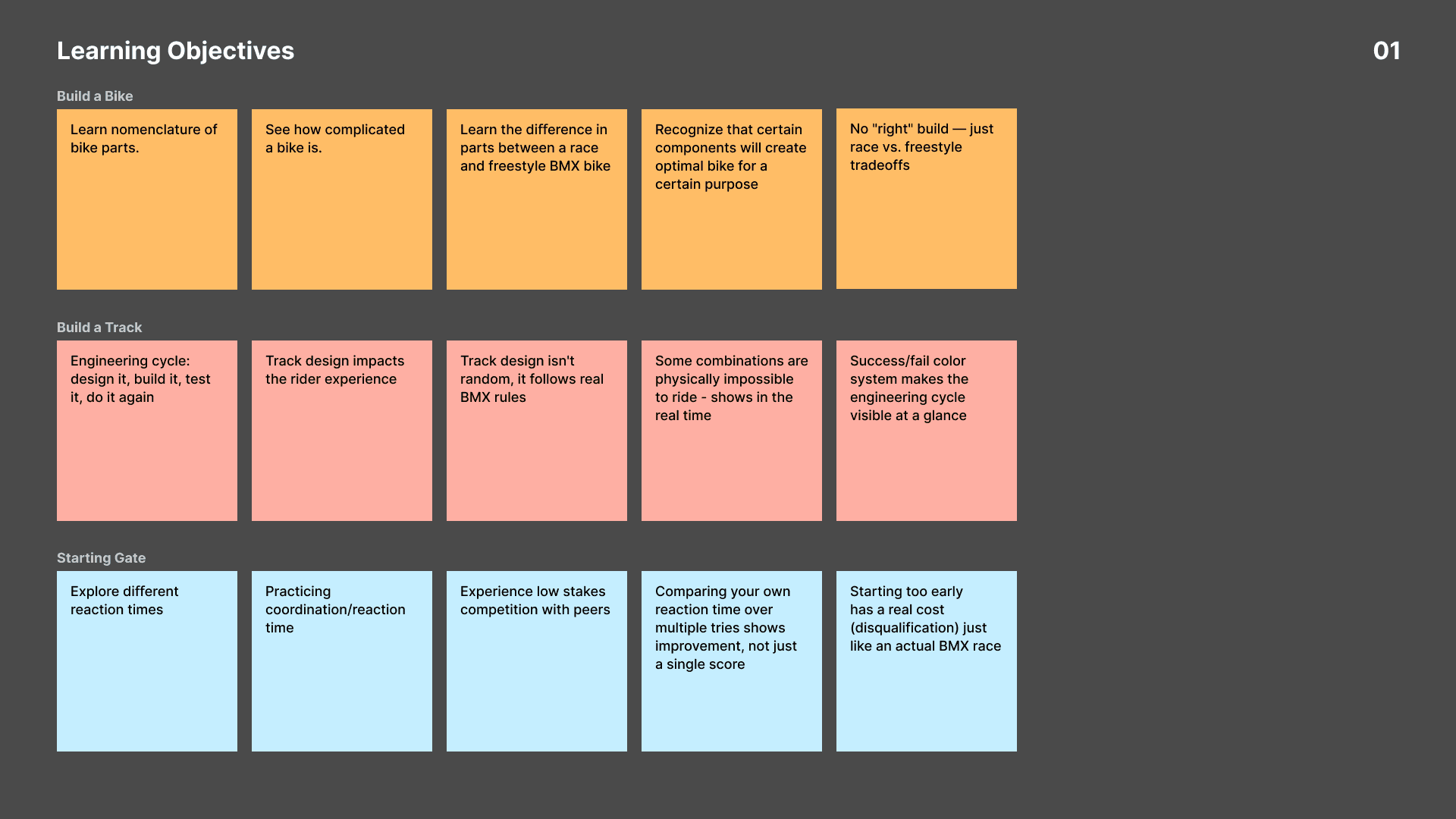
Kickoff with Discovery Lab set distinct learning objectives per interactive: bike nomenclature and race-vs-freestyle differences for Build a Bike, the engineering cycle (design it, build it, test it, do it again) for Build a Track, and reaction time/coordination for Starting Gate.
Early latency testing with Arduino boards shaped how much delay between a physical action and its digital response was tolerable before the illusion broke, and where audio, visual, and physical feedback could reinforce each other — like Starting Gate's countdown tone cueing a pedal press.
Accessibility requirements and Build a Track's fail-state logic — recognizing real BMX obstacle combinations that are physically impossible to ride — were worked through in this phase, before any screen was designed.
Wireframes
Each interactive was wireframed screen-by-screen before any visual design or development began, and each went through real changes once the flow was tested:
Build a Bike
The flow was simplified twice before visual design started: the upfront “Explore vs. Build” choice was cut so visitors could learn about a part while building instead of picking a mode first, and a “Learn more / Go back / Confirm” three-action selector was tested, then reverted to a single “Done” button after it proved confusing mid-task.
Build a Track
Visitors place a block to start and the track builds on screen in real time. The fail state went through the biggest change. Early on, the "Wipeout..." message appeared mid-race, after the visitor had already built and committed to their track. That got reworked so the impossible combination gets caught before the race even starts. The problem blocks turn red and a short pro-tip explains why that combo doesn't work in real BMX. Once visitors build a valid track and complete the race, a success popup appears with their completion time.
Starting Gate
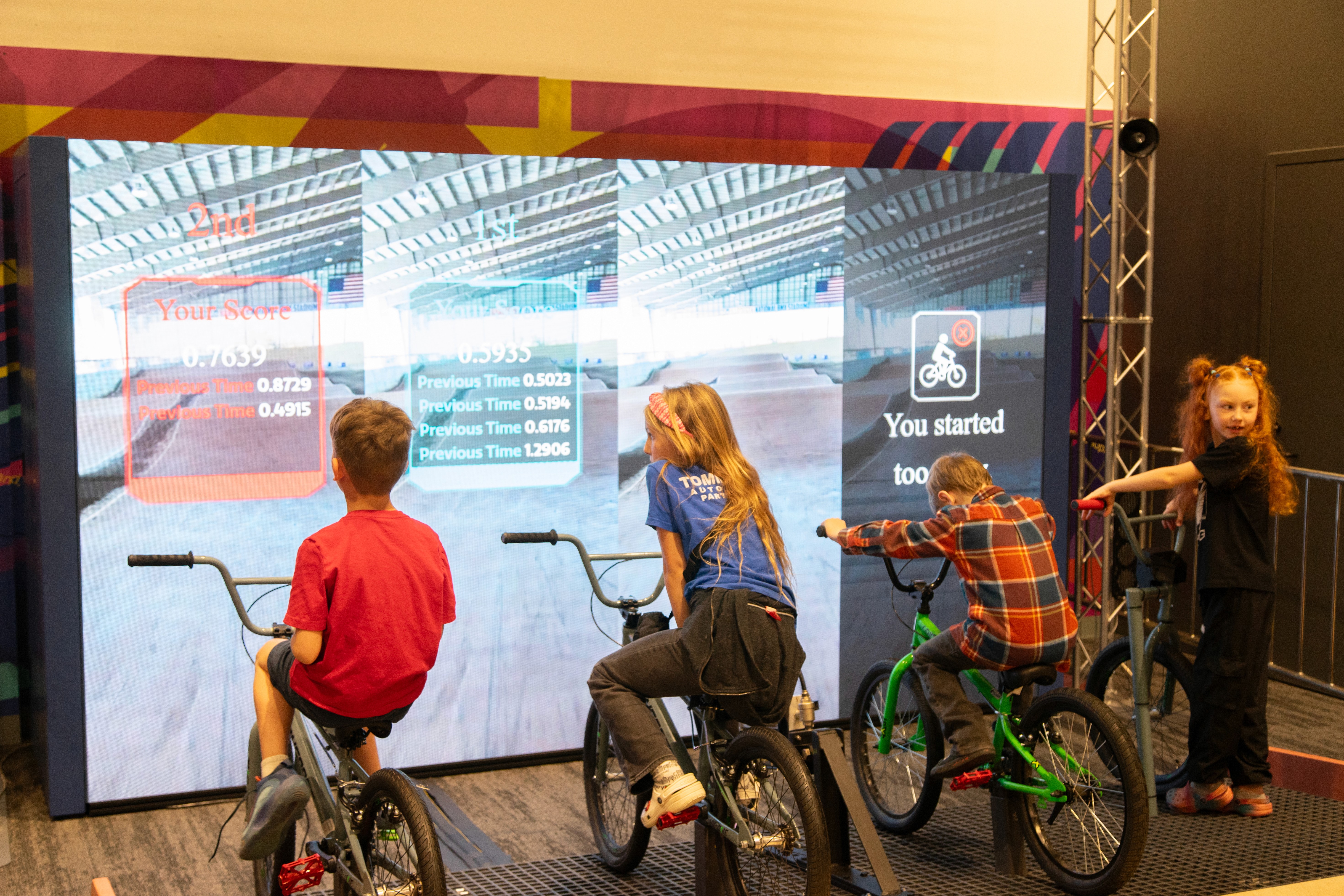
Up to four visitors race from pedal-equipped bike stations, reacting to a randomized countdown on real BMX stack lights. Pressing early gets you disqualified and pressing on cue posts your reaction time and rank against the other riders. Backgrounds were built by 3D artist with me designing the UI layer on top.
Visual Design
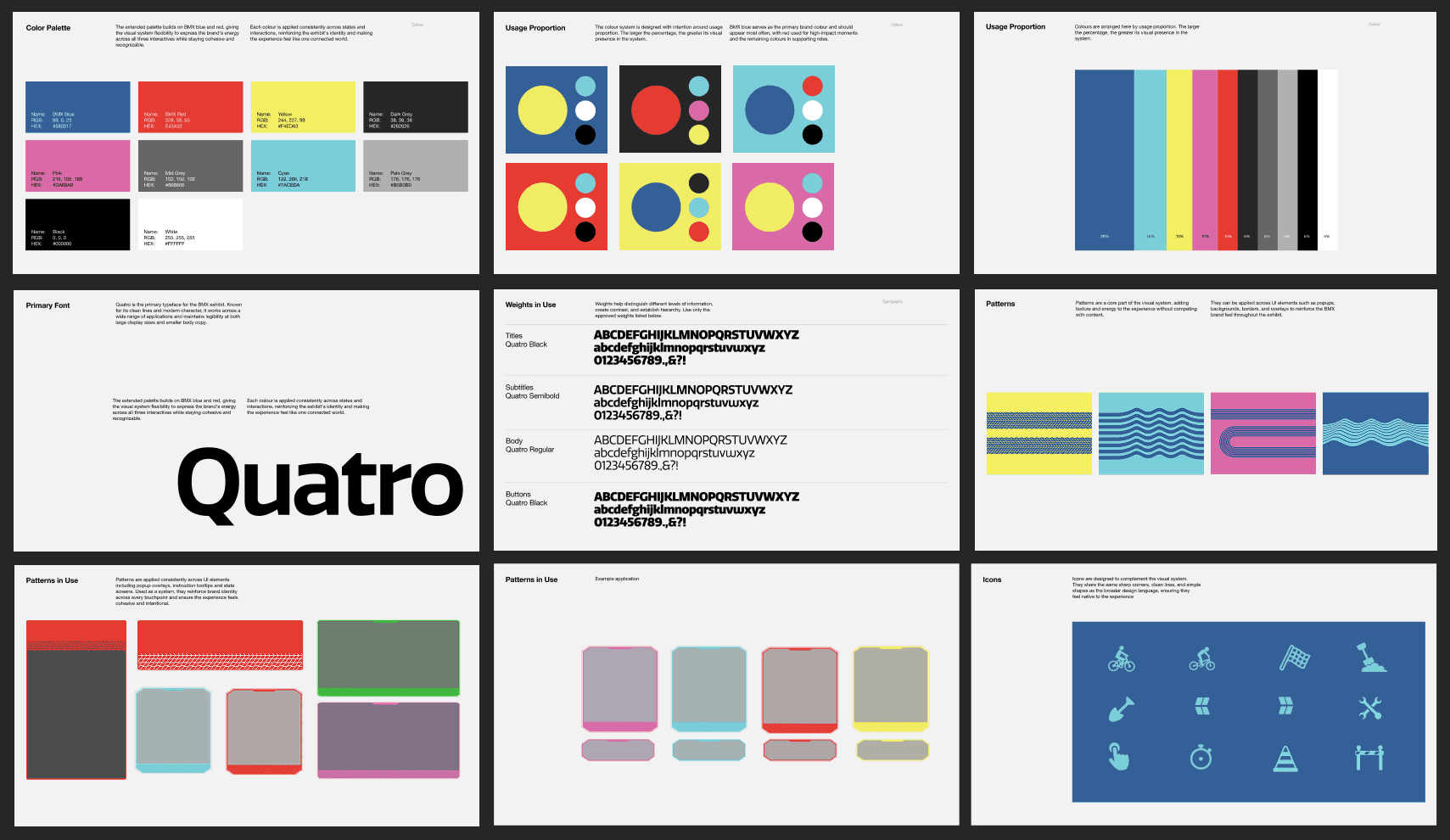
Before designing any screens, I started with a style guide that included the color combinations, type treatment, font usage and UI elements. Having that foundation in place kept all three interactives feeling cohesive but distinct, with the energy of a racing video game throughout.
The style guide was the starting point, but Build a Bike and Starting Gate refined it. Once Discovery Lab saw how that visual language came together, they asked for the same treatment on Build a Track.
Build a Bike
Tested five versions before landing on a blueprint-style background with a light blue and red palette, giving it a DIY feel that matched the act of building a bike. Replaced a text checklist with a labeled anatomy diagram that was easier for visitors to navigate. The bike model fills in with color as parts are chosen, ending in a branded "Riders Ready" postcard visitors can email to themselves.
Starting Gate
Moved from a shared all-time "Top Scores" leaderboard to "Your Score" and "Previous Time" after A/B testing lo-fi wireframes determined users would be more engaged with their own score and Discovery Lab confirmed a personal comparison felt more relevant at an individual station.
Build a Track
The color system from the style guide was applied with clear intent, mapped to a specific state so visitors could understand where they were without reading the text. The fail state added real BMX educational copy from Discovery Lab so a wrong combination became a lesson. Backgrounds were built by 3D artist with me designing the UX/UI layer on top.
Client Collaboration
Discovery Lab was involved throughout, from early wireframe reviews to final content decisions. User testing along the way shaped some of those decisions and the visual design evolved as a result of that ongoing collaboration.
The Experience
Screen by screen
Build a Bike
Visitors can tap any part on the bicycle diagram to zoom in and explore it. While customizing their bike by selecting parts, they learn about each one: its function, weight, material and how it changes between a race and freestyle build.
Starting Gate
Visitors get to experience a real BMX race start. After the countdown, each rider's reaction time posts instantly with a live rank against the other three riders. Their own previous attempt shows too, so it works as both a head-to-head competition and a personal best tracker.
Build a Track
Build a Track puts visitors in the role of a BMX track designer. Each block placed on the physical track appears on screen in real time. A physical button starts the race, showing a first-person view of the track. If two blocks can't be ridden together in real BMX, the problem blocks turn red and a pro-tip appears.


